Atlas of Lost Cities by Aude de Tocqueville & Karin Doering-Froger
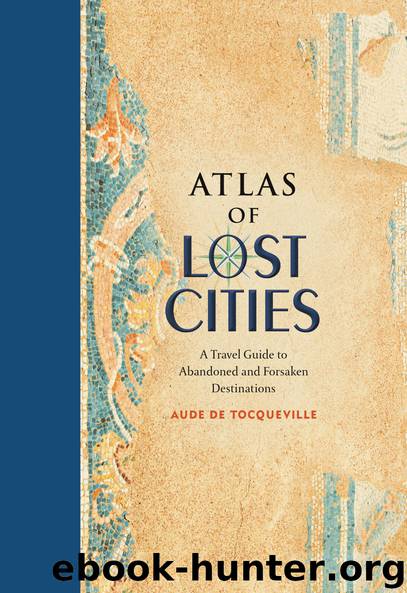
Author:Aude de Tocqueville & Karin Doering-Froger [Unknown]
Language: eng
Format: epub
Publisher: Hachette Books
Published: 2016-04-04T22:00:00+00:00
INDIA · 27°06´N, 77°40´E
FATEHPUR SIKRI
EPHEMERAL CAPITAL
Its pink domes standing out against a milky white sky, the ancient Mughal city of Fatehpur Sikri rises above an immense plain dotted with mustard fields. Emperor Akbar, having reached twenty-six years of age, was worried about not having an heir. He consulted a hermit reputed to be wise, who predicted that a son would be born to him. One year later the prediction came true. Wanting to keep the holy man by his side, Akbar decided to move his capital to the exact spot where the sage lived, on the Sikri Ridge, a rocky plateau southwest of Agra. Work began on the construction of the city in 1572.
Subtly blending Arab, Persian, and Hindu influences, the capital reflects the interests of Akbar, an enlightened and deeply pious monarch with an interest in the arts. And if the austerity of the bare stone causes visitors to forget the time when these palaces resounded with the clatter of arms and the buzz of the court, the architectural fantasies of this inspired place underline the sophistication of Mughal culture. Protected by an encircling wall and dispersed around a vast esplanade are winter and summer residences, the palace of Akbar’s wives (the first was Christian, the second Hindu, and the third Muslim), mosques, terraces, labyrinthine passages, and pavilions and kiosks shaded by awnings—and all this graced by columns, capitals, and elaborate windows whose pink stone is worked as finely as wood. The organization of space is so ingenious that Fatehpur Sikri was to have a major influence on Indian urban planning, notably that of Old Delhi.
For a period of twelve years, from 1573 to 1585, Akbar lived here with his court and harem before leaving to confront the Afghan tribes, at which time he moved his residence to Lahore. For a few months in 1619, Fatehpur Sikri became the seat of the court once again when Jahangir, Akbar’s son, took refuge here in order to escape an epidemic of the plague in Agra. However, several years of drought had got the better of the artificial lake and reservoirs created decades before. Without enough water to satisfy its needs, the court abandoned the city for good, leaving it to slowly fall into ruins. After a long period of neglect, the former capital was eventually rediscovered at the very end of the nineteenth century. Inhabited by monkeys, squirrels, and crows alone, the phantom city extends in all directions around the tomb of the hermit, a masterpiece of carved marble. This has pride of place in the empty court of the great mosque, and rightly so, because had it not been for the holy man, Fatehpur Sikri would never have been built.
Download
This site does not store any files on its server. We only index and link to content provided by other sites. Please contact the content providers to delete copyright contents if any and email us, we'll remove relevant links or contents immediately.
Personalized inhaled bacteriophage therapy for treatment of multidrug-resistant Pseudomonas aeruginosa in cystic fibrosis by unknow(213758)
CONSORT 2025 statement: updated guideline for reporting randomized trials by unknow(102516)
Critical evaluation of the ProfiLER-02 study design and outcomes by Vivek Subbiah & Razelle Kurzrock(102040)
Cardiac gene therapy makes a comeback by Oliver J. Müller & Susanne Hille & Anca Kliesow Remes(101834)
Whisky: Malt Whiskies of Scotland (Collins Little Books) by dominic roskrow(74616)
Unveiling the design rules for tunable emission in graphene quantum dots: A high-throughput TDDFT and machine learning perspective by Şener Özönder & Mustafa Coşkun Özdemir & Caner Ünlü(50997)
A yeast-based oral therapeutic delivers immune checkpoint inhibitors to reduce intestinal tumor burden by unknow(40370)
Covalent hitchhikers guide proteins to the nucleus by Alexander F. Russell & Madeline F. Currie & Champak Chatterjee(40294)
Meet the Authors: Christopher R. Mansfield and Emily R. Derbyshire by Christopher R. Mansfield & Emily R. Derbyshire(40204)
Alkaline-earth metals promote propane dehydrogenation with carbon dioxide through geometric effects: Altering the reaction pathway by unknow(32812)
Induced iron vacancies boosting FeOOH loaded on sustainable Fenton-like collagen fiber membrane for efficient removal of emerging contaminants by unknow(32607)
Efficient electric-field-assisted photochemical conversion of methane to n-propanol exclusively over penetrated TiO2Ti hollow fibers by Guanghui Feng(32527)
Bi2SiO5 nanosheets as piezo-photocatalyst for efficient degradation of 2,4-Dichlorophenol by Hangyu Shi & Yifu Li & Lishan Zhang & Guoguan Liu & Qian Zhang & Xuan Ru & Shan Zhong(32464)
A novel NDIPTA organic heterojunction photocatalyst with built-in electric field for efficient hydrogen production by Jiahui Yang & Baojun Ma & Yongfa Zhu(32437)
Enhanced conversion of methane to liquid-phase oxygenates via hollow ferrite nanotube@horseradish peroxidase based photoenzymatic catalysis by Jun Duan & Shiying Fan & Xinyong Li & Shaomin Liu(32403)
Ordered macroporous superstructure of defective carbon adorned with tiny cobalt sulfide for selective electrocatalytic hydrogenation of cinnamaldehyde by Xiao-Shi Yuan & Sheng-Hua Zhou & San-Mei Wang & Wenbo Wei & Xiaofang Li & Xin-Tao Wu & Qi-Long Zhu(32330)
What's Done in Darkness by Kayla Perrin(27245)
Topological analysis of non-conjugated ethylene oxide cored dendrimers decorated with tetraphenylethylene: Insights from degree-based descriptors using the polynomial approach by A Theertha Nair & D Antony Xavier & Annmaria Baby & S Akhila(26627)
Investigation of mechanical and self-healing properties of hydroxyl-terminated polybutadiene functionalized with 2-ureido-4-pyrimidinone by Mohsen Kazazi & Mehran Hayaty & Ali Mousaviazar(26553)
